
Nox
X-Zero Blue 2026
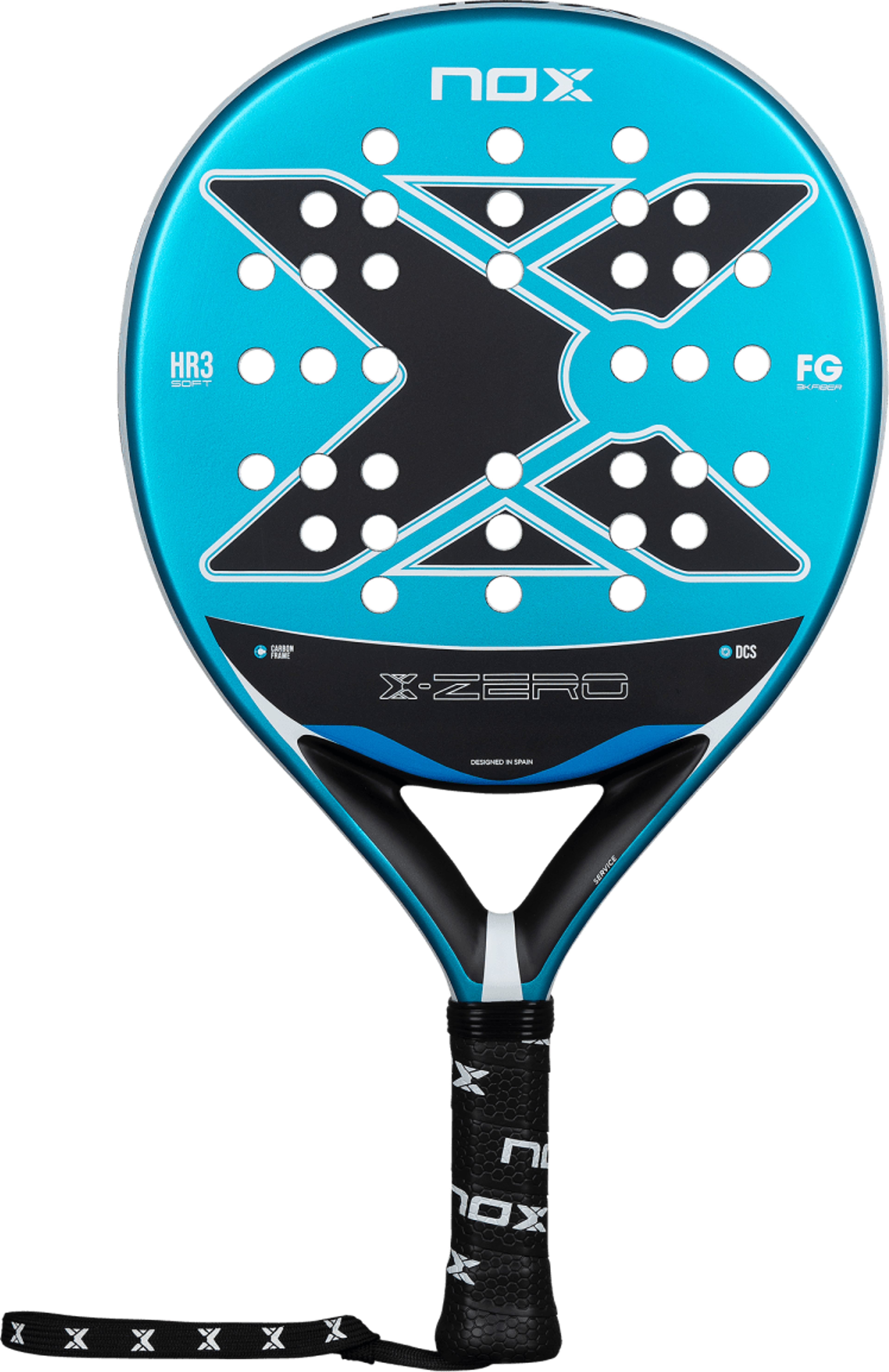
A round, light frame with a widened sweet spot — built for players whose first job is keeping the ball in play, not finishing it.
Where to buy
As an Amazon Associate, Padelhost earns from qualifying purchases at no extra cost to you. This never affects our recommendations.
Amazon
Check price & availability
Link opens in a new tab · we may earn a commission
Full spec breakdown
Listing checked at publish date
Highlights
What makes this racket stand out
Round head with a low balance and 350–360g weight — the racket moves quickly and forgives off-centre contact, which is exactly what a developing player needs
HR3 White EVA core in low density gives a soft, cushioned feel at impact, taking sting out of the wrist and helping players who are still learning timing
Dynamic Composite Structure extends face reinforcement 4cm into the hitting zone, reducing fibre cracks when beginners mishit near the frame edge
The feel
How it's built to play, by shape, core and construction — rated low / mid / high rather than on a false 1–10 scale. Higher isn't always better; it depends on the game you want.
Balance — where the weight sits
Even
Handle / low
Head / high
The spec sheet
Weight
350–360g
Year
2026
Shape
Round
Level
Beginner
Style
All Around
Balance
Low
Core
HR3 White EVA
Face
Fiber Glass 3K
Thickness (mm)
38
Our verdict
What the shape, core and construction tell us about how this racket is built to play.
The short version
The X-Zero Blue 2026 is the right purchase for a player in their first year or two of padel who wants a forgiving frame to build technique on, not a racket they'll grow into. Its strength is how rarely it punishes you for poor contact — the DCS reinforcement and large sweet spot genuinely extend the usable hitting area. The honest limit is the power ceiling: anyone already comfortable finishing points from the left will outgrow it within a season.
Strengths
Beginners and early-intermediate players who need a large sweet spot and a frame that doesn't punish technical errors
Right-side club players who want a light, maneuverable racket for fast volleys and resetting points rather than finishing them
Keep in mind
Advanced players or left-side attackers who want pop on smashes — the soft core and fiberglass face will feel underpowered on overheads
How it's built to play
The X-Zero Blue 2026 sits at the entry point of NOX's catalogue and makes no attempt to pretend otherwise. It's a round, light, low-balance racket with a soft core and a fiberglass face — every spec aimed at making the ball easier to find and easier to keep in play. What separates it from a generic beginner frame is the construction detail around the sweet spot and the frame-to-face transition, which addresses the two ways cheap rackets typically fail beginners: small effective hitting area, and cracks from off-centre impacts.
The face is built from Fiber Glass 3K — three layers of fiberglass weave that thicken the hitting surface for durability rather than chasing the stiffness of a carbon face. On contact the face flexes slightly, giving a small trampoline effect that helps generate ball speed even on slow, tentative swings. The HR3 White EVA core is the soft variant of NOX's HR3 rubber family: low density, long dwell time on the ball, plenty of vibration absorption. Power comes from the player's swing, not the racket — but for a learner that's the right trade.
The Dynamic Composite Structure (DCS) is the spec worth understanding. NOX extends extra composite material from the frame inwards by about 4cm, so there's no sudden hardness step between the rigid frame and the softer face. In practice this means fewer broken fibres when a beginner clips the ball near the frame — the kind of mishit that destroys cheaper rackets within a season. The carbon frame around the perimeter adds rigidity where the racket needs to hold its shape; the rest is built for feel.
At 350–360g with the weight pulled toward the handle, the X-Zero Blue swings noticeably faster than its 38mm profile suggests. Defensive volleys at the net come easily, and the racket recovers fast between shots — useful for right-side players who are constantly resetting. The enlarged sweet spot is the headline benefit on the bandeja and on backhand volleys: contact slightly off-centre still produces a usable shot rather than a dead reply.
The limitation is exactly what you'd expect. Step into a smash or try to finish a point from the left side and the racket runs out of energy. The soft HR3 core absorbs more than it returns at high swing speeds, and the fiberglass face doesn't have the stiffness to punch the ball deep. This is a racket for keeping the rally going until your opponent makes a mistake — not for forcing one.
FAQ
Is the X-Zero Blue 2026 actually suitable for a complete beginner?
Yes — this is one of the few rackets in NOX's range explicitly built around forgiveness rather than performance. The round shape centres the sweet spot, the low balance keeps the racket fast in the hand, and the HR3 White EVA core softens impact for players who haven't yet developed clean contact. If you're past your first year and already smashing confidently, look at the Equation or Pro Cup lines instead.
How does the X-Zero Blue 2026 compare to the X-Zero Red?
Both share the same X-Zero platform — round shape, low balance, HR3 White EVA core, Fiber Glass 3K face — so the playing characteristics are essentially identical. The difference is cosmetic colourway. Choose whichever you prefer visually; on court they perform the same.
Should I choose the NOX X-Zero Blue or step up to a Bullpadel Flow?
Both are round, control-oriented beginner-to-intermediate rackets with low balance and arm-friendly construction. The Flow tends to sit slightly heavier and has a marginally firmer feel; the X-Zero Blue is softer at contact and lighter to swing, making it the safer pick for a player still developing wrist and forearm strength. If you already have racket-sport experience, the Flow gives more room to grow.
Is the X-Zero Blue 2026 a good choice for players with elbow problems?
It fits the low-risk profile reasonably well: round shape, low balance, soft HR3 core, fiberglass face, light weight. That combination reduces vibration transmission compared to a stiff carbon-and-EVA diamond. It's not a medical guarantee, but for a club player managing mild elbow sensitivity it's a sensible option — pair it with good technique and a properly fitted overgrip.
What does the Dynamic Composite Structure actually do for my game?
DCS extends the face's composite reinforcement about 4cm in from the frame, smoothing out the hardness difference between the rigid carbon frame and the softer hitting surface. The practical effect: when you hit the ball near the edge of the face — which beginners do constantly — the fibres are less likely to crack and the response feels more uniform across the racket, not just in the centre.
Made for elbow-conscious players.
A round, light frame with a widened sweet spot — built for players whose first job is keeping the ball in play, not finishing it.
Link opens in a new tab · we may earn a commission