
Bullpadel
XPLO COMFORT 25
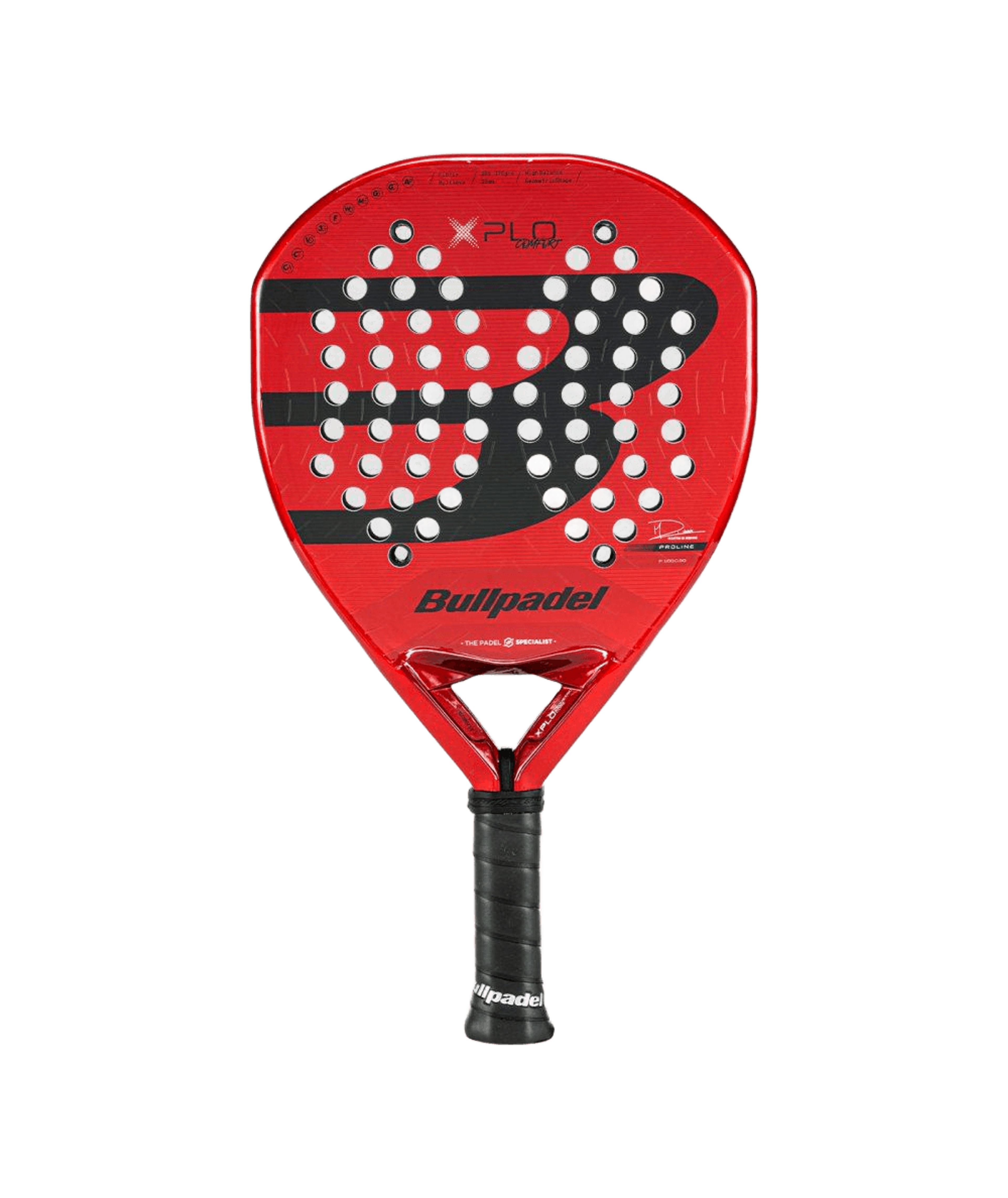
The full attacking geometry of the XPLO line, dialled back just enough for players whose arms need to last the whole match.
Where to buy
As an Amazon Associate, Padelhost earns from qualifying purchases at no extra cost to you. This never affects our recommendations.
Amazon
Check price & availability
Link opens in a new tab · we may earn a commission
Full spec breakdown
Listing checked at publish date
Highlights
What makes this racket stand out
Geometric Shape frame widens at 2 and 10 o'clock to push the sweet spot higher and expand the hitting surface to 535 cm² — the largest in Bullpadel's range, which means off-centre smashes stay in play more often than on a standard diamond.
Fibrix face (glass fibre + carbon hybrid bonded with flexible resin) absorbs more vibration at contact than a full-carbon face — the trade-off is slightly less explosive snap-back, but you'll feel the difference across a two-hour session, not on a single shot.
Ease Vibe dampeners in four strategic holes absorb up to 49% of impact vibration, and the Vibradrive rubber insert in the handle splits the grip assembly to intercept what's left — two independent vibration-reduction systems on one racket is unusual at this price point.
The feel
How it's built to play, by shape, core and construction — rated low / mid / high rather than on a false 1–10 scale. Higher isn't always better; it depends on the game you want.
Balance — where the weight sits
Even
Handle / low
Head / high
The spec sheet
Weight
365–375g
Year
2024
Shape
Teardrop
Level
Advanced
Style
Power
Balance
High
Core
Multieva
Face
Fibrix
Thickness (mm)
38
Our verdict
What the shape, core and construction tell us about how this racket is built to play.
The short version
The XPLO Comfort 25 is the left-side attacking racket for players who have already learned that playing through elbow pain is a short-term strategy — the Fibrix face and dual vibration-damping system lower the physical cost of aggressive play without gutting the power that makes the XPLO geometry worth choosing. The honest limitation is touch: the softened face and high balance make precise defensive resets and dink volleys harder to calibrate than on a medium-balance all-rounder. If your game is built around finishing points from overhead, that's a trade you'll make without hesitation.
Strengths
Attacking club players on the left side who want XPLO-level overhead and smash power but have a history of elbow sensitivity that makes a full-carbon, stiff-faced racket a gamble over a long season.
Advanced all-court players transitioning to a more aggressive, head-heavy style who need the high balance and expanded sweet spot to carry them while their technique catches up.
Keep in mind
Right-side players focused on defensive resets and consistent volleys — the high balance slows the swing on quick hands exchanges and the power bias will push controlled placement shots long.
How it's built to play
The XPLO Comfort 25 occupies a specific and genuinely useful gap in Bullpadel's 2024 lineup: it takes the Geometric Shape frame — the widened, high-balance, maximum-surface-area construction that makes the XPLO line so destructive overhead — and swaps the full-carbon face for Fibrix, a hybrid of glass fibre and carbon bonded in flexible resin. The result is not a watered-down XPLO. It's the same attacking geometry with a face that bends slightly more at contact, reducing the vibration spike that carbon faces send straight up the arm. For players who want to play aggressively but can't ignore what that means for their elbow over time, that's a meaningful difference.
The Geometric Shape frame is the starting point: by widening the frame at the 2 and 10 o'clock positions, Bullpadel increases the ball-contact surface to 535 cm² and shifts the sweet spot toward the top of the head. The Hexature internal frame — a hexagonal tube running the perimeter with 3mm added wall thickness — locks that geometry in place under load, so the frame doesn't flex or twist when you make contact near the edge of that expanded surface.
The Fibrix face is where the XPLO Comfort 25 separates from its siblings. Standard XPLO models run X-Tend Carbon faces; here, the glass fibres in the Fibrix weave introduce a degree of flex that slightly extends dwell time at contact. The MultiEVA core underneath is a three-layer sandwich — denser outer EVA for fast balls, softer inner EVA for slower ones — which means the core itself is already doing some speed-adaptive work. Fibrix on top of MultiEVA makes for a more forgiving contact envelope than carbon over MultiEVA, without abandoning the stiffness needed for power transfer on hard swings. Vibradrive in the handle and Ease Vibe dampeners in four face holes handle what vibration remains — and the Custom Weight system lets players add up to 9g to the protector zone if they want to push the balance even further toward head-heavy.
"Fibrix on a geometric diamond: the soft face broadens the contact window without softening the attacking intent — comfort and geometry working in the same direction."
The first thing you notice is that the racket feels lighter in transition than 365–375g suggests. Air Power — Bullpadel's enlarged throat channel that increases airflow by 50% — is doing visible work here: the swing arc accelerates quickly, which matters on overhead approaches where timing windows are tight. On smashes from the left side, the high balance and Geometric Shape combine to produce a shot that carries more than you'd expect from the effort invested.
"Air Power plus high balance makes the overhead arrive faster than the weight suggests — that's the comfort story, not a reduction in attacking intent."
Where the comfort story becomes real is in the third set. The Fibrix face doesn't give you the crisp, dry crack of full carbon on a clean hit — there's a marginally softer quality to the contact that some advanced players will find slightly vague on touch volleys. But it also means that off-centre hits and mishit volleys don't send a sharp vibration spike into the forearm the way a stiffer face does. The Smart Holes pattern — no perforations on the longitudinal axis — stiffens the central face area to maintain power output, and the 3D Grain roughening works consistently for slice and topspin effects from the back of the court.
FAQ
How does the XPLO Comfort 25 compare to the standard XPLO 25?
The key difference is the face material. The XPLO 25 uses X-Tend Carbon 12K — a biaxial carbon weave that gives a stiffer, more direct energy transfer and a crisper feel at contact. The XPLO Comfort 25 replaces that with Fibrix, a glass-carbon hybrid bonded with flexible resin, which introduces more flex at the face and absorbs more vibration. Both rackets share the same Geometric Shape frame, Hexature internal structure, high balance, and MultiEVA core, so the power geometry is identical. The Comfort version is the right choice if you want the same attacking platform but need to manage arm fatigue or elbow sensitivity — the standard XPLO 25 is the choice if maximum snap-back and carbon feedback matter more to you than comfort.
Should I choose the XPLO Comfort 25 or the Bullpadel Vertex 05 if I play on the left?
Both are high-balance attacking rackets, but they serve different attacking profiles. The Vertex 05 is a conventional diamond shape with X-Tend Carbon face — it's stiffer, more direct, and better suited to players with clean technique who want maximum feedback and power ceiling on overheads. The XPLO Comfort 25 uses the wider Geometric Shape frame with a Fibrix face, which gives a larger effective sweet spot (535 cm²) and lower vibration. If your smash technique is consistent and you want the most explosive response, the Vertex is sharper. If you play long sessions, have any arm sensitivity, or are still refining your overhead, the XPLO Comfort 25 is the more forgiving path to left-side attacking play without giving up meaningful power.
Is the XPLO Comfort 25 2024 suitable for players with tennis elbow?
It's a lower-risk option within the high-balance attacking category, but it's not a low-risk racket overall. The Fibrix face, MultiEVA core, Ease Vibe dampeners, and Vibradrive handle together create four layers of vibration management — that's genuinely unusual and does reduce the impact shock compared to a full-carbon, stiff-cored equivalent. However, the high balance and head-heavy geometry still generate significant force at the arm on overhead shots, and the Smart Holes design stiffens the central face to preserve power. If you're actively recovering from elbow problems, a round or teardrop racket with low balance and a soft foam core is a safer rehabilitation choice. The XPLO Comfort 25 is better described as 'arm-considerate' than 'arm-safe' — it may suit players with mild elbow sensitivity who refuse to give up an attacking game, but anyone with a serious injury history should consult a physiotherapist before choosing it.
What does the Custom Weight system on the XPLO Comfort 25 actually let me do?
Custom Weight lets you add aluminium adhesive plates — 3g each, up to a maximum of 9g — into compartments built into the protector at the top of the racket head. On the XPLO Comfort 25, Bullpadel has positioned these entirely in the upper zone, which means every gram you add shifts the balance further toward head-heavy. At maximum (9g added), you're meaningfully increasing the moment of inertia on smashes — the head carries more through the swing, which translates to more pace on overhead shots if your technique can handle the extra weight. If you prefer a faster, more manoeuvrable feel, leave the plates out. It's a practical way to tune one racket to two slightly different playing demands without buying a second frame.
Is the XPLO Comfort 25 a good choice for an advanced player moving from a teardrop to a more attacking racket?
It's a reasonable step-up racket for that transition, specifically because the Geometric Shape expands the sweet spot beyond what a standard diamond or even a conventional teardrop offers. Players moving from a forgiving teardrop will notice the higher balance immediately — shots that felt natural from mid-court will carry more on overheads, but quick hands at the net require adjustment. The Fibrix face softens the learning curve compared to a full-carbon XPLO model, so mishits don't punish as sharply during the adaptation period. The caveat is weight: at 365–375g with a high balance, this is not a light racket to transition on, and players under 70kg or with limited upper-body strength may find sustained overhead play tiring. If you're in that category, the standard XPLO 25 at a similar price point but potentially lighter spec, or a teardrop with medium-high balance, might be a more gradual bridge.
Made for elbow-conscious players.
The full attacking geometry of the XPLO line, dialled back just enough for players whose arms need to last the whole match.
Link opens in a new tab · we may earn a commission