
Bullpadel
NEURON PREMIER
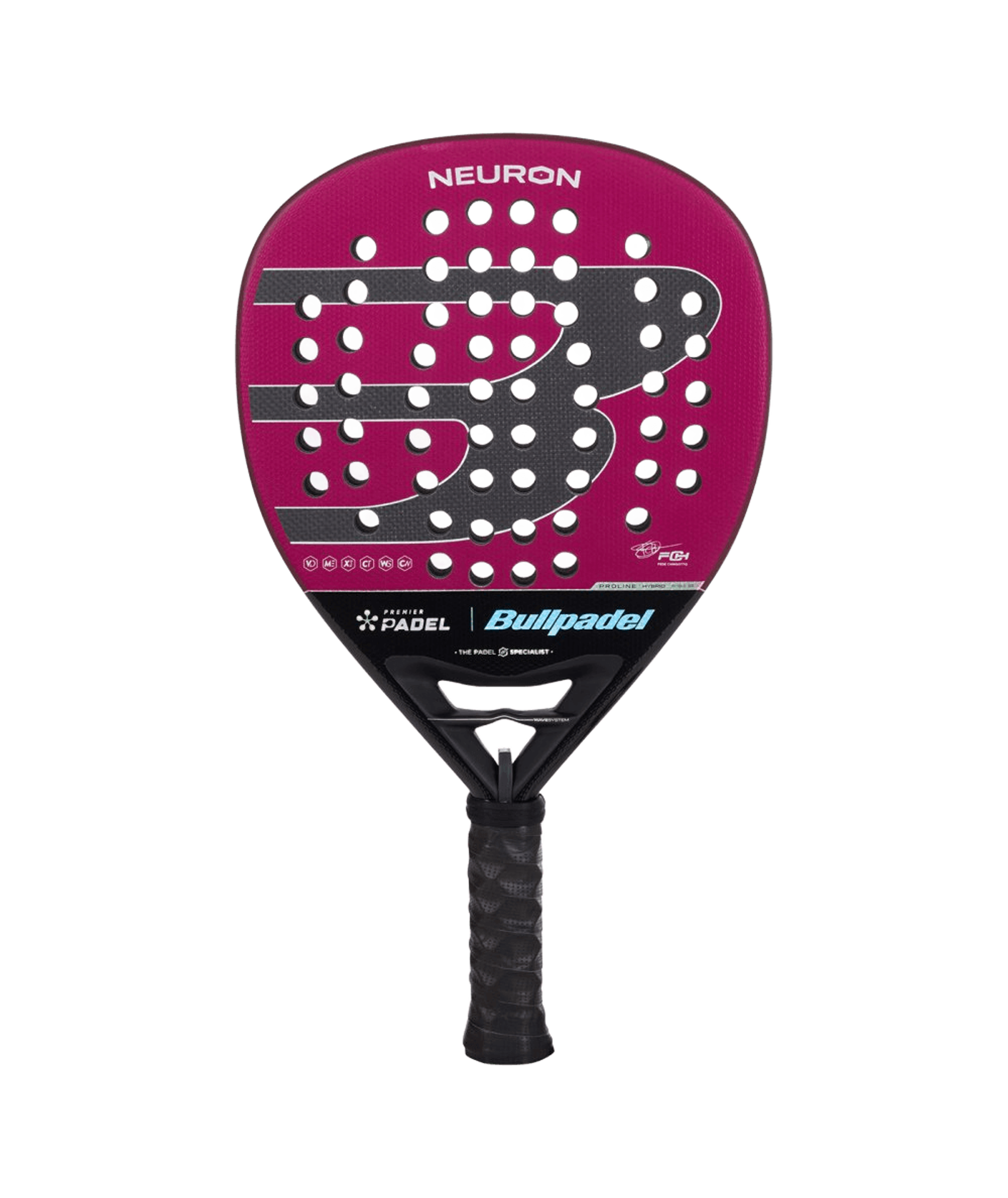
A teardrop control frame that turns anticipation into a weapon — for players who dominate through placement, not pace.
Where to buy
As an Amazon Associate, Padelhost earns from qualifying purchases at no extra cost to you. This never affects our recommendations.
Amazon
Check price & availability
Link opens in a new tab · we may earn a commission
Full spec breakdown
Listing checked at publish date
Highlights
What makes this racket stand out
Wave System frame construction alternates stiffness and flexibility along the perimeter, producing a dry, planted feel at contact that makes ball direction feel deliberate rather than accidental
X-Tend Carbon 3K face — 3,000-filament dense carbon weave — delivers precise energy transfer with no spring assist, meaning every touch shot lands exactly where you put it
Low balance combined with the Wave Bridge internal crossbar reduces torsion on off-centre hits, so the frame doesn't twist when you're stretched wide under pressure
The feel
How it's built to play, by shape, core and construction — rated low / mid / high rather than on a false 1–10 scale. Higher isn't always better; it depends on the game you want.
Balance — where the weight sits
Even
Handle / low
Head / high
The spec sheet
Weight
355–375g
Year
2025
Shape
Teardrop
Level
Professional
Style
Control
Balance
Low
Core
Multieva
Face
X Tend Carbon 3K
Thickness (mm)
38
Our verdict
What the shape, core and construction tell us about how this racket is built to play.
The short version
The Neuron Premier suits the technically disciplined right-side player who wants carbon-face precision without the elbow punishment of a head-heavy attacking frame — its low balance and Wave System construction make it one of the more arm-considerate options in Bullpadel's carbon range. The X-Tend Carbon 3K face is unforgiving on mishits and generates no pace of its own, so players who haven't yet developed consistent contact should look elsewhere. At €369.99, you're paying for a racket designed around a specific, advanced style of play — and it delivers on that promise without pretending to be anything else.
Strengths
Right-side players who control the pace of rallies through placement and reset the point rather than finishing it overhead
Advanced club players who have consistent technique and want a carbon-face racket that rewards touch and spin over brute power
Keep in mind
Left-side attackers looking to finish points from overhead — the low balance and control-oriented construction will feel underpowered on aggressive smashes
How it's built to play
The Neuron Premier is Bullpadel's clearest statement of what a control racket should be at professional level: a teardrop frame with low balance, a dense 3K carbon face, and a construction philosophy centred entirely on making the ball go exactly where you intend. Designed with Federico Chingotto — a player who wins by reading play early and redirecting pace rather than creating it — the Neuron Premier is not trying to be a power racket dressed in disguise. It is unambiguously a precision tool, and it doesn't apologise for that.
The face is X-Tend Carbon 3K — the tighter, finer weave in Bullpadel's carbon family. Where the 12K variant on the Vertex line prioritises elasticity and snap-back for power, the 3K construction is deliberately stiffer, transmitting contact almost without delay. Paired with the MultiEVA core — a three-layer EVA sandwich where the inner layer is higher-density for a firm baseline response, flanked by softer outer layers that absorb vibration on slower exchanges — the Neuron Premier manages to feel firm without feeling harsh. The Smart Holes pattern reinforces this: by concentrating holes away from the central face, the hitting zone stays rigid and directional control is more repeatable.
The Wave System frame is the structural detail that separates the Neuron line from standard carbon builds. The undulating frame geometry alternates stiffness and flexibility at specific points along the perimeter, dissipating longitudinal vibration rather than concentrating it at impact. The Wave Bridge — a horizontal internal crossbar across the throat — adds torsional resistance so the frame holds its shape when the ball catches the edge of the sweet spot. CarbonTube wraps the entire perimeter in 100% bidirectional carbon. The Custom Weight system allows handle-end plates (5g or 10g) to be added, nudging the balance even lower for players who want faster hand speed.
"Wave System alternates stiffness and flexibility along the perimeter to dissipate vibration — rather than a uniformly rigid wall that concentrates every shock at the contact point."
On court, the Neuron Premier plays as its specs suggest: fast through the air, planted at contact, and unambiguously weighted toward the handle. Right-side volleys feel secure — there is very little vibration through the arm on clean contacts, and the low balance means the racket accelerates quickly into position for balls that arrive with pace. The 3D Grain surface texture increases friction on the face, which matters when you're working the ball with slice or angled underspin from the back of the court. The Hesacore grip and Vibradrive handle assembly work together to filter residual shock, so extended sessions at the baseline feel noticeably less fatiguing than a standard carbon frame.
"Hit the ball late or off-centre and the X-Tend Carbon 3K face communicates it clearly — there's no fiberglass forgiveness covering for timing errors."
What stands out is how transparent the racket is about contact quality. Hit the ball late or off-centre and the 3K carbon face communicates it clearly. That honesty is a feature for an experienced player building consistency, but it's a genuine problem for anyone whose technique is still developing. Defensive lobs, redirected passing shots, and touch volleys near the net are where it earns its price.
FAQ
How does the Neuron Premier compare to the Neuron 02 Edge TF 25?
The Neuron 02 Edge TF 25 sits at a lower price point and uses a softer face construction aimed at intermediate-to-advanced players still developing their carbon touch. The Neuron Premier uses the stiffer X-Tend Carbon 3K face, the full Wave System + Wave Bridge frame architecture, Hesacore grip, and Vibradrive handle — all features that sharpen precision and reduce vibration at the cost of forgiveness. If you're confident your technique is consistent, the Premier's 3K face will give you cleaner directional feedback; if you're not there yet, the Edge TF 25 is a more realistic step up.
Should I choose the Neuron Premier or the Bullpadel Vertex series if I want a carbon racket?
These rackets are built for opposite ends of the court. The Vertex line — diamond shape, high balance, X-Tend Carbon 12K — is engineered for left-side attackers who finish points overhead. The Neuron Premier is teardrop, low balance, and 3K carbon, designed for right-side control and placement. If you play both sides or play right, the Neuron Premier is the correct choice. If you specialise on the left and your game is built around smashes and overhead finishing, the Vertex is the better fit.
Is the Neuron Premier suitable for players with elbow sensitivity?
Relatively speaking, yes — for a carbon-face racket. The low balance keeps the weight toward the handle, which reduces the lever effect on the arm. The MultiEVA core's softer outer layers absorb some vibration on slower balls, and both the Hesacore grip and Vibradrive handle assembly are specifically designed to filter shock before it reaches the hand. That said, the X-Tend Carbon 3K face is stiffer than fiberglass and will transmit more vibration on hard or off-centre hits than a softer foam and fiberglass combination. Players recovering from a serious elbow injury should consult a physio before committing to any carbon-face racket.
What does the Wave System actually do compared to a standard carbon frame?
A conventional frame is a rigid tube — vibrations from impact travel directly along it to your arm. The Wave System builds an undulating geometry into the frame perimeter, which means the energy has to navigate curves rather than travel in a straight line. This dissipates vibration more gradually and reduces the spike of shock at contact. On court it translates to a drier, more settled feel — the ball leaves the face with a firm, precise sensation rather than the resonant 'ping' you get from a conventional stiff frame. The Wave Bridge crossbar adds torsional stability on top of that, so the frame doesn't torque when the ball catches the edge of the sweet spot.
What does the Custom Weight system do on the Neuron Premier, and should I use it?
The Neuron Premier's Custom Weight system places aluminium plates in the handle protector — you can add a 5g or 10g plate at the butt end. Adding weight here lowers the balance point further, making the racket feel even more handle-heavy, which increases hand speed and makes the frame more manoeuvrable. Right-side players who feel the racket is already too slow through the air may benefit from the added counterbalance. Players who want marginally more stability on hard-paced incoming balls might prefer to leave it unweighted. Start without the extra weight and add it only if you feel the racket is too quick and lacks solidity.
Made for elbow-conscious players.
A teardrop control frame that turns anticipation into a weapon — for players who dominate through placement, not pace.
Link opens in a new tab · we may earn a commission