
Bullpadel
IONIC LIGHT 26
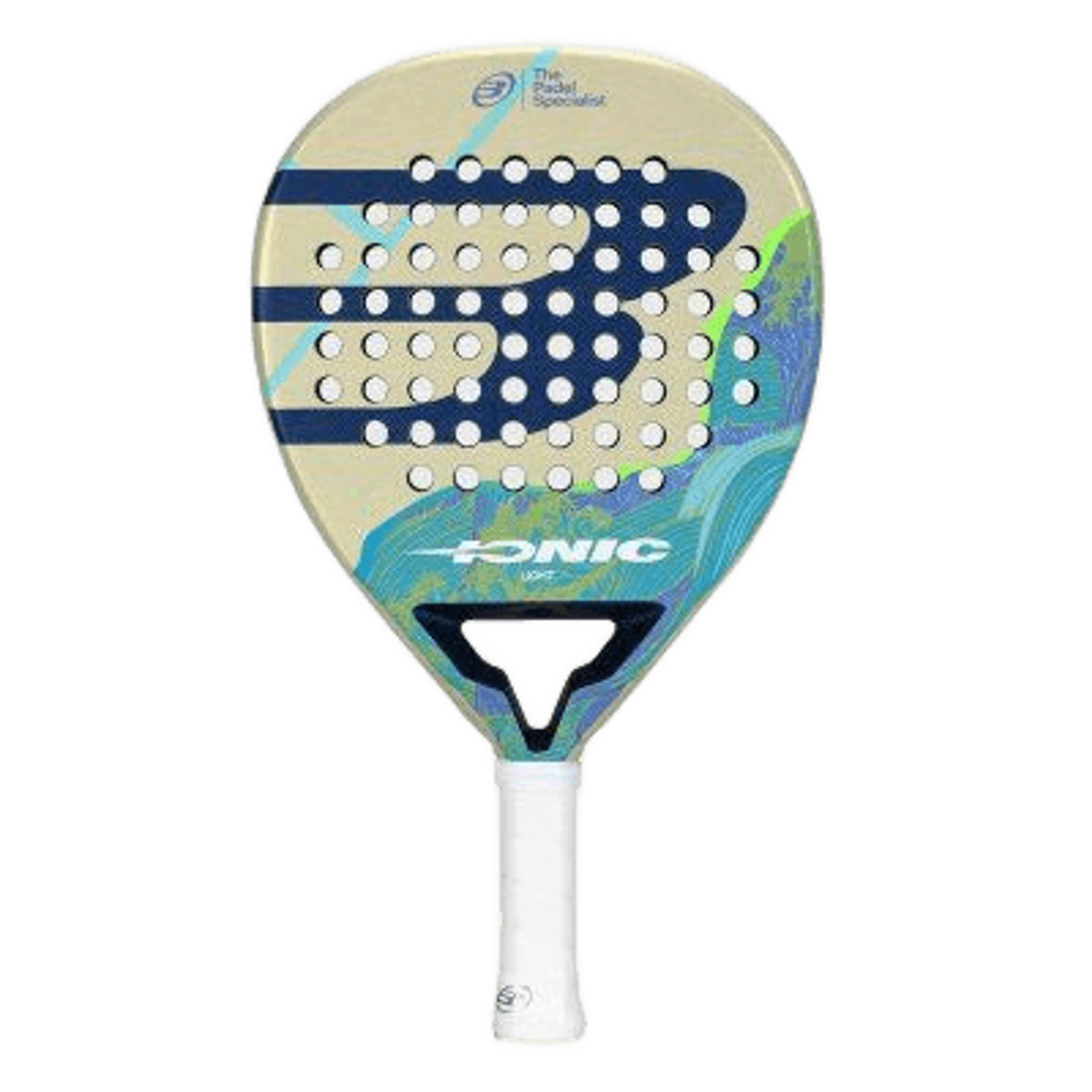
A light hybrid frame built for all-court players who need quick reactions without giving up the ability to push forward when the moment arrives.
Where to buy
As an Amazon Associate, Padelhost earns from qualifying purchases at no extra cost to you. This never affects our recommendations.
Amazon
Check price & availability
Link opens in a new tab · we may earn a commission
Full spec breakdown
Listing checked at publish date
Highlights
What makes this racket stand out
At 350–360g it's genuinely light for a 38mm teardrop-profile racket — faster through the air than most in its class
MultiEVA's dual-density core handles both slow defensive exchanges and sharper attacking balls without needing a technique change
Glaphite face blends fiberglass flexibility with carbon stiffness — more responsive than pure fiberglass, more forgiving than full carbon
The feel
How it's built to play, by shape, core and construction — rated low / mid / high rather than on a false 1–10 scale. Higher isn't always better; it depends on the game you want.
Balance — where the weight sits
Even
Handle / low
Head / high
The spec sheet
Weight
350–360g
Year
2026
Shape
Teardrop
Level
Intermediate
Style
All Around
Balance
Medium
Core
MultiEva
Face
Glaphite
Thickness (mm)
38
Our verdict
What the shape, core and construction tell us about how this racket is built to play.
The short version
The Ionic Light 26 is the right call for the developing all-court player who wants a light, fast frame that doesn't demand a fixed playing position — its Glaphite face and MultiEVA core give it more nuance than its price suggests. The limitation is real though: the medium balance and sub-360g weight cap its overhead punch, so anyone whose game is trending toward left-side attacking will outgrow it within a season. Buy it to get better across the whole court, not to start finishing points.
Strengths
Intermediate players covering both sides of the court who want a single racket that doesn't force a playing style
Players stepping up from a beginner round racket who want to add more punch without sacrificing control or arm comfort
Keep in mind
Advanced left-side attackers who rely on overhead smashes and bandeja pace — the medium balance and light weight won't generate enough momentum for consistent finishing
How it's built to play
The Ionic Light 26 sits in a pragmatic corner of Bullpadel's lineup: not trying to be a power racket, not trying to be a pure control tool, but genuinely useful for the club player who's still figuring out whether they prefer to defend or attack. At €149.99 and with a spec sheet built around versatility over specialisation, it makes a strong case for players who play two or three times a week and need a racket that keeps up with their developing game rather than outpacing it.
The Glaphite face is where the Ionic Light 26 earns its price. Glaphite is Bullpadel's own hybrid weave — carbon filaments blended with fiberglass strands — and the result is a face that flexes slightly more than pure carbon at contact, giving the ball a touch more dwell time and reducing the harsh snap-back that stiffens cheaper full-carbon faces. For an intermediate player who doesn't yet generate consistent racket head speed, that slight give translates to shots that stay predictable even on slightly off-centre contact. The 3D Grain texture on the face adds meaningful friction — topspin and slice effects that would otherwise require deliberate brush technique happen more naturally, which is genuinely useful at this level rather than just a marketing texture.
The Carbon Tube frame — 100% bidirectional carbon around the perimeter — keeps the build rigid where it matters. At only 350–360g the risk with lighter rackets is that the frame flexes torsionally on harder hits, producing that hollow, unstable sensation. The Carbon Tube construction resists that deformation, so the Ionic Light 26 feels more planted on impact than its weight suggests. The XForce reinforcement inside the frame adds a further layer of stiffness along the side walls, amplifying shot output without adding grams. The MultiEVA core handles the energy management: the denser outer EVA layer rebounds fast enough to give attacking shots pace, while the softer inner layer cushions the slower defensive exchanges.
"XForce side-wall reinforcement amplifies shot output without adding grams — at 350–360g this is how you make a light racket feel substantial without padding the weight."
From the baseline and mid-court, the lightness is the first thing you notice. Volleys arrive fast and the racket is already back in position before a heavier frame would have finished its follow-through. That speed is the Ionic Light 26's most honest strength — it suits the player who wins points by staying in rallies, moving well, and waiting for the right moment rather than forcing openings through power alone. On the right side particularly, the medium balance and light swing weight mean consistent, unhurried volleys under pressure.
"The medium balance and light swing weight make right-side volleys feel unhurried even under pressure — which is more useful in a long point than extra power on the smash."
Where it begins to run out of headroom is on overhead finishing shots from the left. The medium balance means there's no real weight behind the head at the top of a smash swing — you're relying on arm strength and technique rather than momentum, and for an intermediate player that gap becomes apparent quickly. Players who have committed to the left side and want to start finishing points consistently should look higher in the Ionic range or consider stepping up to a teardrop with higher balance.
FAQ
How does the Ionic Light 26 compare to the Ionic Power 26?
The Ionic Power 26 is built around higher balance and a stiffer construction aimed at generating more pace from attacking strokes — it costs €30 more and rewards players who already play with intent on the left side. The Ionic Light 26 trades some of that overhead punch for a faster, lighter swing weight that suits all-court players who are still developing their positional game. If you're not yet consistently playing from the left and finishing points overhead, the Light 26 is the better fit at its price.
Should I choose the Ionic Light 26 or last year's Ionic Light 25?
The Ionic Light 26 introduces the Glaphite face, replacing the previous generation's standard fiberglass. That's a meaningful upgrade — Glaphite's carbon-glass hybrid construction is more responsive and wears better than plain fiberglass, especially if you play regularly. The 25 may be available at a discount, but the face material improvement alone makes the 26 worth the difference for anyone planning to use the racket for more than one season.
Is the Ionic Light 26 suitable for players with elbow sensitivity?
It's a relatively low-risk profile. The light weight (350–360g) reduces swing fatigue, the medium balance keeps vibration transmission lower than a head-heavy racket, and the MultiEVA core's inner soft layer absorbs shock on slower contacts. The Glaphite face is also more flexible than full carbon, which helps dampen impact. It's not a dedicated arm-recovery racket, but it doesn't stack the high-risk factors — diamond shape, high balance, hard EVA, full carbon — that cause most padel elbow problems. Players with active elbow issues should still warm up properly and consider an overgrip for added handle dampening.
What does MultiEVA actually do differently from a standard EVA core?
A single-density EVA core responds the same way regardless of whether the ball arrives fast or slow — you either get good power on hard shots and a harsh feel on soft ones, or vice versa. MultiEVA uses two EVA densities in layers: the outer layer is denser and reacts to fast balls with more rebound and pace, while the inner layer is softer and cushions slower exchanges for better control. In practice, it means the Ionic Light 26 doesn't punish you for a defensive reset ball the way a purely hard EVA core would, and still gives enough pop when you do push forward.
Is 350–360g too light to generate power at the intermediate level?
For most intermediate all-court players, no — it's actually a benefit. Players at this level typically gain more from better racket speed and control than from raw mass. A heavier racket generates more power on smashes but demands more arm strength and slows recovery time between shots. At 350–360g the Ionic Light 26 swings fast enough to keep up with quick exchanges and lets you focus on technique rather than forcing the shot. If you're consistently hitting hard, accurate overheads from the left and finding the ball coming off weakly, that's the signal to move to a heavier, higher-balance racket — but most intermediate players aren't there yet.
Made for elbow-conscious players.
A light hybrid frame built for all-court players who need quick reactions without giving up the ability to push forward when the moment arrives.
Link opens in a new tab · we may earn a commission