
Bullpadel
INDIGA W 26
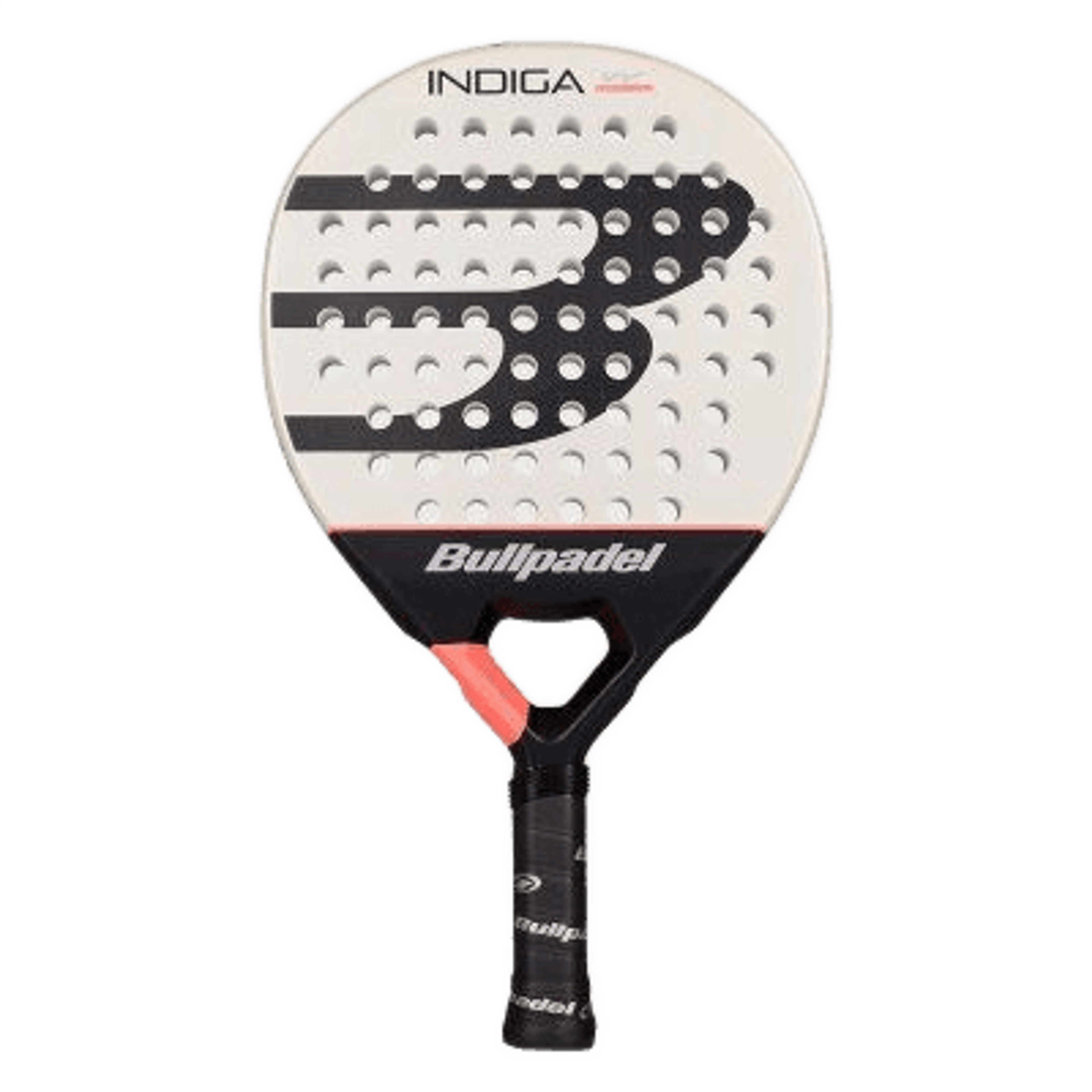
A forgiving round frame tuned for players who are still building consistency — light enough to react quickly, soft enough to absorb the mistakes that come with learning.
Where to buy
As an Amazon Associate, Padelhost earns from qualifying purchases at no extra cost to you. This never affects our recommendations.
Amazon
Check price & availability
Link opens in a new tab · we may earn a commission
Full spec breakdown
Listing checked at publish date
Highlights
What makes this racket stand out
Round shape with low balance keeps the sweet spot central and the swing effortless — mishits stay in play instead of flying wide
Soft Eva core absorbs impact and slows the ball's exit speed, giving new players more time to direct their shots rather than chase rebounds
Carbon Tube frame adds structural rigidity without increasing weight, so the racket feels solid at contact rather than hollow or flexing unpredictably
The feel
How it's built to play, by shape, core and construction — rated low / mid / high rather than on a false 1–10 scale. Higher isn't always better; it depends on the game you want.
Balance — where the weight sits
Even
Handle / low
Head / high
The spec sheet
Year
2026
Shape
Round
Level
Beginner
Style
Control
Balance
Low
Core
Soft Eva
Face
Polyglass
Our verdict
What the shape, core and construction tell us about how this racket is built to play.
The short version
The Indiga W 26 suits the player who is starting out and wants a racket that makes the learning process less physically punishing — its low balance and soft materials reduce arm strain and keep mishits manageable rather than humiliating. The honest limitation is that it will feel underpowered faster than most beginners expect; once consistent groundstrokes and basic net play are established, the Soft Eva and Polyglass combination stops providing feedback and starts feeling like a ceiling. Buy it to learn on, not to grow into.
Strengths
Players in their first year of padel who need maximum forgiveness and want to build consistent technique without fighting the racket
Players with elbow sensitivity or returning from arm injuries who need low vibration and a light, handle-biased swing
Keep in mind
Intermediate or advanced players — the Soft Eva core and Polyglass face offer almost no feedback on well-struck balls, which becomes frustrating once technique is established
How it's built to play
The Indiga W 26 is Bullpadel's entry-level control racket, built around a combination of specs that point firmly in one direction: maximum forgiveness for players who are still learning. The round shape, low balance, Soft Eva core, and Polyglass face are not accidental choices stacked together — each one reduces the penalty for off-centre contact, and together they make a racket that is genuinely easy to play with from the first session.
The Polyglass face is Bullpadel's branded fiberglass — a flexible material that bends slightly at contact and creates a mild trampoline effect. For a beginner hitting at slower swing speeds from the back of the court, that flex generates ball speed the player's technique can't yet produce on its own. It's forgiving on mishits too, because the material absorbs some of the energy from off-centre strikes rather than transmitting it as a jarring vibration up the arm. The Soft Eva core works in the same direction: lower-density foam that lets the ball sink briefly into the face before releasing, extending dwell time and giving the player a fraction longer to feel the shot. That translates directly to more control and less shock at impact. The Carbon Tube frame — 100% bidirectional carbon around the perimeter — might seem like an odd choice on an entry-level racket, but it prevents the frame from flexing and twisting during contact, which keeps the face stable even when the swing isn't perfectly timed.
"Polyglass flex plus Soft Eva dwell: two forgiveness layers in the same racket — the arm cost of learning padel is meaningfully lower here than on a harder-core beginner build."
On court, the low balance is the first thing you notice. The weight sits toward the handle, so the racket swings faster than its specs suggest and doesn't drag the arm through the stroke. That matters most on volleys close to the net, where reaction time is everything and a head-heavy racket would feel sluggish. The round shape keeps the sweet spot in the centre of the face — larger and more central than a teardrop or diamond — which means points played from the right side are where this racket is most at home.
"The round shape and Soft Eva core keep the first session comfortable — no jarring feedback, no heavy arm — which is the most important spec a beginner racket can have."
What it won't do is reward aggressive overhead play from the left. The Soft Eva core absorbs rather than rebounds, so smashes feel muted, and the low balance offers no momentum assist on attacking strokes. That's not a flaw — it's a feature for someone whose game doesn't yet include reliable overheads — but it means the racket's ceiling is clearly defined.
FAQ
How does the Indiga W 26 compare to the Indiga CTR 26?
Both are round, beginner-oriented rackets in the 2026 Indiga range, but the CTR 26 is the control-focused sibling with a slightly different construction tuned for shot placement. The W 26 prioritises lightness and arm comfort above all — if vibration reduction and manageability are the priority, the W 26 is the right call. If you want marginally more feedback on controlled exchanges and aren't worried about arm sensitivity, the CTR 26 is worth comparing side by side.
How does the Indiga W 26 compare to the Indiga PWR 26?
The PWR 26 is built around power — likely a harder core and stiffer face — while the W 26 goes the opposite direction with Soft Eva and Polyglass for comfort and control. For a beginner, the W 26 is the safer starting point: the PWR 26's power profile only pays off once technique is consistent enough to direct the extra pace. Anyone coming back from an elbow issue should avoid the PWR 26 and stay with the W 26's softer setup.
Is the Indiga W 26 suitable for players with tennis elbow?
It has a low-risk profile for arm sensitivity. The combination of round shape, low balance, Soft Eva core, and Polyglass face ticks almost every box for reducing vibration transmission — the ball dwells on the face longer, the balance keeps swing momentum away from the head, and the flexible fiberglass face absorbs some impact rather than transferring it directly to the arm. No racket can guarantee injury prevention, but this construction is about as arm-friendly as padel equipment gets at this price point.
Will the Indiga W 26 still work once I improve beyond beginner level?
Probably not for long. The Soft Eva core and Polyglass face provide almost no feedback on well-struck balls — once you're hitting consistently from mid-court and starting to develop net play, you'll feel the racket absorbing pace you want to use. Most players outgrow this type of construction within 12–18 months of regular play. When that happens, the Indiga CTR 26 or a teardrop-shape mid-range model would be the natural next step.
What does the Carbon Tube frame actually do on a beginner racket?
Carbon Tube means the frame perimeter is wrapped in 100% bidirectional carbon fibre, which makes the frame walls rigid and resistant to twisting on impact. On a light beginner racket this matters more than it sounds — without a stiff frame, off-centre hits cause the face to flex and rotate, sending the ball unpredictably and sending vibration into the arm. The Carbon Tube keeps the face stable even when the swing isn't perfect, which is exactly what a player at initiation level needs most.
Made for elbow-conscious players.
A forgiving round frame tuned for players who are still building consistency — light enough to react quickly, soft enough to absorb the mistakes that come with learning.
Link opens in a new tab · we may earn a commission