
Bullpadel
INDIGA BOY 26
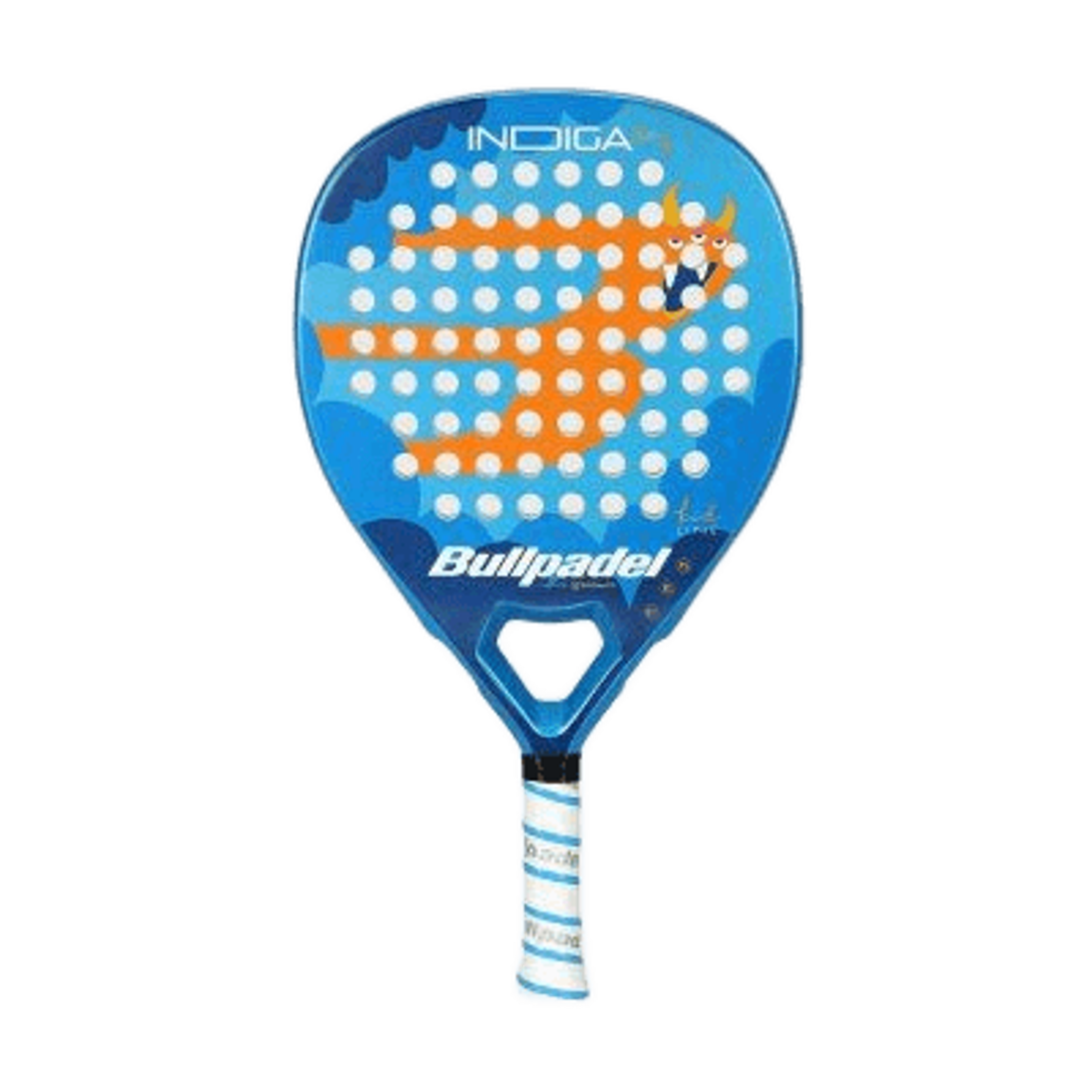
A junior teardrop built around one idea: teaching a child the right grip before bad habits take hold.
Where to buy
As an Amazon Associate, Padelhost earns from qualifying purchases at no extra cost to you. This never affects our recommendations.
Amazon
Check price & availability
Link opens in a new tab · we may earn a commission
Full spec breakdown
Listing checked at publish date
Highlights
What makes this racket stand out
Grip Zone marking on the frame helps young players position their non-dominant hand correctly from the very first session — correcting the most common beginner mistake before it becomes habit
Evalastic foam core keeps the feel soft and forgiving on mishits, so early contact errors don't punish small arms with jarring vibration
Ultra-light build sized for a child's hand reduces fatigue across a full session — the grip circumference is designed for small hands, which matters more than the colour scheme
The feel
How it's built to play, by shape, core and construction — rated low / mid / high rather than on a false 1–10 scale. Higher isn't always better; it depends on the game you want.
Balance — where the weight sits
Even
Handle / low
Head / high
The spec sheet
Year
2026
Shape
Round
Level
Beginner
Style
All Around
Balance
Medium
Core
Evalastic
Face
Polyglass
Our verdict
What the shape, core and construction tell us about how this racket is built to play.
The short version
The Indiga Boy 26 is a beginner junior racket that does one thing no generic junior racket does: it physically guides correct grip technique through the Grip Zone, making it a better coaching tool than most options at this price. The Polyglass face and Evalastic core keep the feel forgiving enough that early mistakes don't discourage. Any child who outgrows it in confidence and technique should move straight to a heavier, longer junior frame — the Indiga has done its job by then.
Strengths
Children aged roughly 7–10 taking their first steps in padel who need a racket that actively teaches correct grip technique rather than just being small and light
Young players starting at initiation level who benefit from the wide sweet spot and forgiving Evalastic core building confidence on early ground strokes and volleys
Keep in mind
Adult or teenage players — the grip circumference is sized for small children's hands, and the frame length and weight are calibrated for a junior body, not a developed swing
How it's built to play
The Indiga Boy 26 exists for one purpose: getting a young child onto a padel court and keeping them there long enough to enjoy it. Bullpadel has built the whole racket around two problems every junior beginner faces — not knowing where to put the non-dominant hand, and hitting the ball off-centre and giving up. The Grip Zone and a wide Evalastic sweet spot are the answers to both. At this price point and for this audience, that focus is the right call.
The face is Polyglass — Bullpadel's branded fiberglass material — which flexes slightly on contact to create a small trampoline effect. On a junior swing that lacks pace and force, that flex matters: it helps the ball travel even when the stroke isn't fully loaded. The core is Evalastic, an elastic rubber-foam compound that cushions impact well and maintains its rebound consistency over time — important for a racket that will take plenty of mis-hits before the technique develops. The frame uses a Carbon Tube construction, meaning the perimeter is built from 100% bidirectional carbon, which adds structural rigidity without adding weight. For a junior racket this is a genuine benefit: a stiffer frame holds its shape and doesn't deaden after repeated low-power strikes the way cheaper mixed-material builds can. The Grip Zone is a shaped area on the frame matrix that visually and tactilely guides correct non-dominant hand placement during the ready position and stroke preparation — that single feature separates the Indiga from a generic junior racket.
"Evalastic maintains its rebound consistency across a full season — budget foam cores compress and go dead, which is the failure mode a junior racket needs to avoid most."
In play, the teardrop shape with medium balance keeps the sweet spot slightly above centre — accessible without being as high as a diamond, and larger than a diamond's contact zone. A child who mishits toward the throat or the tip still gets a usable return rather than a dead ball. The light weight means no shoulder fatigue during long rally practice, and the Evalastic core absorbs the vibration that would otherwise travel up a small arm on repeated strikes.
"The Grip Zone gives a coach something to point to and a child something to feel for — wrong grip becomes actively uncomfortable rather than invisible, which shortens the correction curve significantly."
The Grip Zone pays off during coaching sessions: an instructor can immediately see and correct hand placement on the non-dominant side, which shortens the learning curve significantly. Don't expect the racket to teach power — it won't, and it shouldn't. At this stage, consistent contact and correct mechanics are the only outcomes worth measuring.
FAQ
What age and size is the Bullpadel Indiga Boy 26 designed for?
The '26' in the name refers to the racket length in inches, which is the standard junior sizing for children roughly aged 7 to 10, depending on their height. The grip is sized for small hands, so if a child is already approaching adult hand size, a 27-inch junior racket or an adult light model will fit better. Length fit matters more than age — a taller 9-year-old may already need the next size up.
How does the Indiga Boy 26 compare to the Indiga PWR 26 and Indiga CTR 26?
The Indiga Boy 26 is the entry-level initiation model at €59.99, focused entirely on grip learning and forgiving contact through Evalastic foam and Polyglass face. The Indiga PWR 26 and Indiga CTR 26 sit at €89.99 and introduce more performance-oriented specs — the PWR leaning toward power output and the CTR toward control precision. Both of those are better suited to juniors who already have basic technique and want to develop their game further. Start with the Boy 26 and graduate to PWR or CTR once consistent contact is established.
What is the Grip Zone and does it actually help a child learn padel?
The Grip Zone is a shaped, textured area built into the racket's frame matrix that guides where the non-dominant hand should rest during stroke preparation and the continental grip position. It doesn't force the hand into place, but it gives a clear tactile reference that a child can feel and an instructor can reference during coaching. The practical result is faster correction of the most common beginner error — incorrect off-hand placement — before it becomes an ingrained habit. It's a genuinely useful feature, not a marketing label.
Is the Carbon Tube frame necessary on a junior beginner racket?
It might seem like overkill, but Carbon Tube — Bullpadel's 100% bidirectional carbon frame — adds structural rigidity that actually benefits a junior racket in a specific way: it prevents the frame from deforming or deadening under repeated low-power strikes. Cheaper mixed-material frames at this size can feel hollow and inconsistent after a few months of use. The Carbon Tube perimeter keeps the response predictable for longer, which matters when a child is building their feel for the ball.
Should I buy the Indiga Boy 26 or the Indiga Girl equivalent for a beginner child?
The technical specs between the Boy and Girl Indiga 26 models are functionally identical — same shape, same Evalastic core, same Polyglass face, same Grip Zone. The difference is cosmetic: colour scheme and graphics. Choose whichever the child prefers the look of. The grip circumference is the same across both, so fit is not a factor in the decision.
Made for elbow-conscious players.
A junior teardrop built around one idea: teaching a child the right grip before bad habits take hold.
Link opens in a new tab · we may earn a commission