
Bullpadel
HACK 04 26
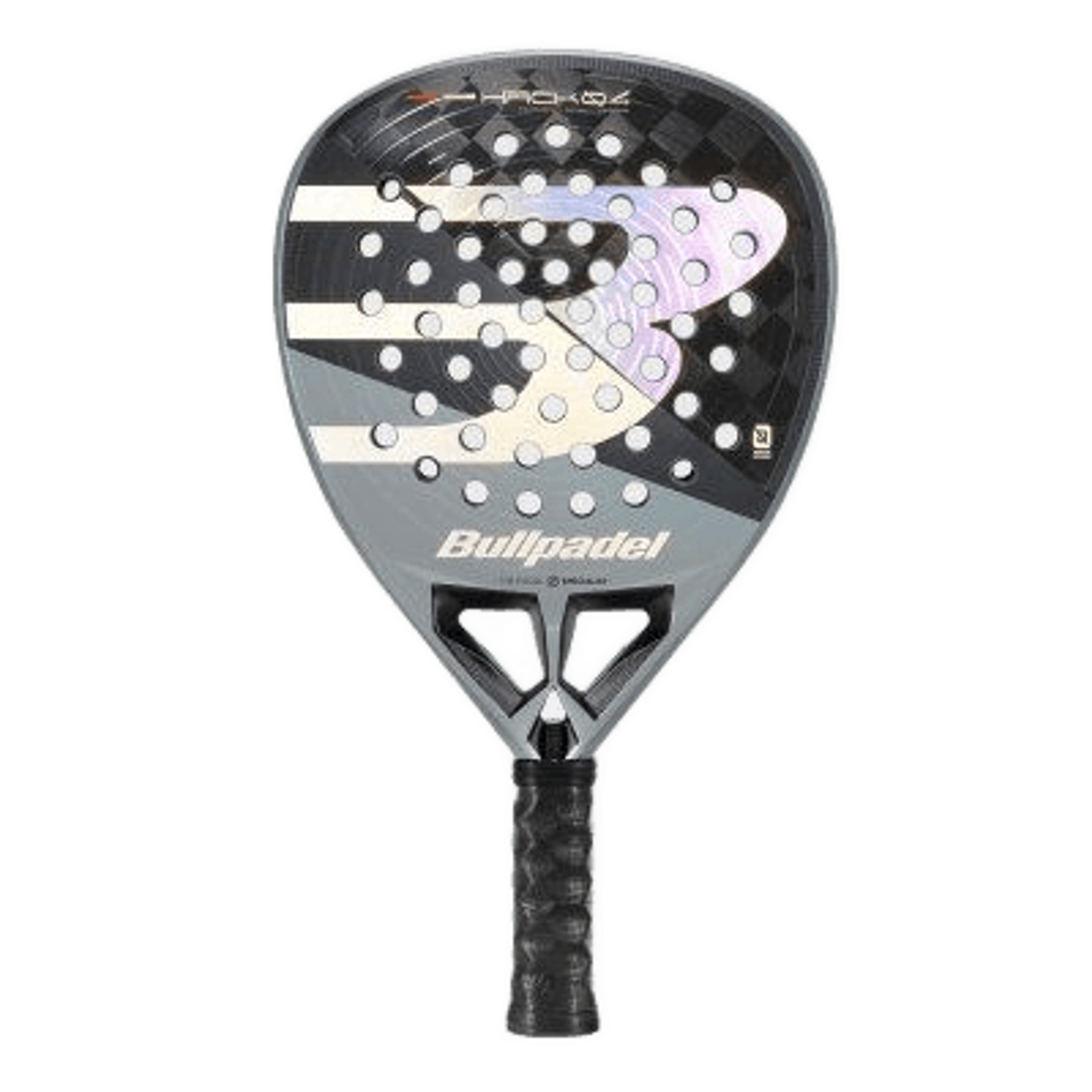
A high-balance diamond built around swing speed — the kind of racket that turns aggressive footwork into points finished overhead.
Where to buy
As an Amazon Associate, Padelhost earns from qualifying purchases at no extra cost to you. This never affects our recommendations.
Amazon
Check price & availability
Link opens in a new tab · we may earn a commission
Full spec breakdown
Listing checked at publish date
Highlights
What makes this racket stand out
Total Channel runs the aerodynamic groove around the entire frame perimeter — not just the throat — measurably reducing air resistance so the racket accelerates faster through the hitting arc than previous Hack generations
TriCarbon 18K face uses 18,000 ultra-fine filaments woven in three directions, giving the face a faster snap-back after impact than the stiffer 3K weave — more explosive ball exit speed without the deadened feel of a purely stiff carbon
MultiEVA triple-density core matches the frame's attacking intent: the outer EVA layers detonate on fast, hard strikes while the softer inner layer absorbs pace on slower balls, keeping the racket usable below top swing speed
The feel
How it's built to play, by shape, core and construction — rated low / mid / high rather than on a false 1–10 scale. Higher isn't always better; it depends on the game you want.
Balance — where the weight sits
Even
Handle / low
Head / high
The spec sheet
Weight
365–375g
Year
2026
Shape
Diamond
Level
Professional
Style
Power
Balance
High
Core
Multieva
Face
TriCarbon 18K
Thickness (mm)
38
Our verdict
What the shape, core and construction tell us about how this racket is built to play.
The short version
The Hack 04 26 is a left-side specialist's racket — it earns its price in the overhead game, where the aerodynamic frame, explosive 18K carbon face, and high balance converge into something that genuinely accelerates faster than comparable diamonds at this weight. The problem is what that specialisation costs: anyone who can't consistently strike from the sweet spot will find the stiff Carbon Tube frame punishing, and the high-balance diamond combination is not for players managing any arm sensitivity regardless of how many vibration-dampening layers sit between the frame and their hand. Buy it knowing exactly what it is.
Strengths
Left-side attackers with consistent overhead technique who want to convert mid-court pace into finishing shots
Advanced all-court players who prioritise swing speed and aggressive net positioning over defensive retrieval
Keep in mind
Players with elbow or shoulder sensitivity — the diamond shape, high balance, and Carbon Tube frame combine three high-risk factors for vibration transmission
How it's built to play
The Hack line has spent a decade as Bullpadel's power flagship, and the 04 26 edition doesn't rewrite that identity — it sharpens it. The central engineering decision this generation is the Total Channel: a hollow aerodynamic groove that now wraps the entire frame perimeter rather than stopping at the throat. Bullpadel's own data puts the aerodynamic gain at 17% over a non-channelled frame. Whether or not you trust the number, the on-court consequence is real — the swing arc feels lighter than 375g suggests, which matters most when you're late on a fast incoming ball and need to generate pace from a compressed swing.
The TriCarbon 18K face is the most interesting construction decision on this racket. Where the 3K weave used on lower-tier models produces a denser, drier surface that prioritises precision, the 18K tridirectional weave is more open — lighter per layer, with more elasticity built into the fibre architecture itself. That translates to quicker rebound after impact rather than a pure transfer of force. Pair that with the Carbon Tube frame — 100% bidirectional carbon around the perimeter — and you have a structure with exceptional torsional resistance: the frame doesn't flex or twist on off-centre contact, so energy doesn't bleed sideways on mishits.
Inside, the MultiEVA core runs three EVA layers at different densities. The two outer layers are compact and high-density, reacting sharply to fast-ball exchanges; the inner layer is softer. The Tricore structure reinforces this further, thickening the internal vectors in the heart of the racket to reduce resonance on hard strikes and give the frame a planted, solid contact feel rather than a ringing one. Vibradrive in the handle — a high-elasticity rubber component splitting the handle longitudinally — adds a final layer of vibration management before impact energy reaches the hand. Combined with the Hesacore grip's honeycomb design, the Hack 04 does more arm protection work than most attacking diamonds.
"Tricore thickens the internal heart vectors to reduce resonance — the result is a 'thud' at contact rather than a ring, which tells you the energy went into the ball, not into the frame."
The shape of the Hack 04 26's sweet spot — pushed high into the head by the diamond geometry and high balance — means the racket is built for one moment: the overhead finishing shot from the left side. Bandejas, smashes, and aggressive volleys struck from that zone feel immediate and direct, with the TriCarbon 18K face releasing the ball fast enough that opponents rarely have time to reset. The 3D Grain rough surface adds strong friction at contact, so topspin and slice effects are more pronounced than on a smooth carbon face.
"TriCarbon 18K release speed plus 3D Grain friction: pace and spin from the same shot, which is what makes a bandeja from the left side genuinely threatening rather than just deep."
Away from that overhead zone, the racket is less forgiving. The Smart Holes pattern — holes removed from the central face area to increase rigidity — tightens the feel across the whole surface. The Custom Weight system adds a useful layer of personalisation: four positions at the top of the frame can each accept 3g gel plates. The Ease Vibe dampeners in four strategic holes, studied by the Polytechnic University of Madrid to absorb up to 49% of vibrations at impact, give players one more tuning variable.
FAQ
How does the Hack 04 26 compare to the Hack 04 25?
The 04 26 introduces the full perimeter Total Channel — on the 04 25, the aerodynamic channel ran through the throat area only. The 2026 version extends it around the entire frame, which Bullpadel claims delivers 17% better aerodynamics and 7% more torsional stability. The TriCarbon 18K face and MultiEVA core carry over, so the fundamental attacking character is unchanged — the 26 edition is faster through the air and marginally stiffer in the frame. If you're on the 04 25 and happy with it, the upgrade is real but incremental. If you're buying new, the 04 26 is the version to get.
Should I choose the Hack 04 26 or the Bullpadel Vertex 05?
Both are attacking diamonds at the professional level, but they sit differently in the hand. The Vertex line uses X-Tend Carbon 12K and Air Power, tuning it toward all-court versatility with a slightly more accessible sweet spot for players who mix offensive and defensive play. The Hack 04 26 with TriCarbon 18K and Total Channel is narrower in intent — it's built specifically around swing speed and overhead power for players who spend most of the match on the left side finishing points. If you're transitioning into a pure attacking role on the left, the Hack 04 26; if you need a diamond that still performs when you're defending, the Vertex 05.
Is the Hack 04 26 suitable for a strong intermediate player or is it genuinely professional-only?
The professional label is accurate here, not marketing inflation. The combination of diamond shape, high balance at approximately 264mm, and a stiff Carbon Tube frame with 18K carbon face demands consistent technique — particularly a clean, repeatable swing plane and reliable overhead contact. A strong intermediate who plays 3–4 times a week and has developed their left-side game could manage it, but they will feel the unforgiving nature of the sweet spot on off-days. If you're still working on consistent volleys or mid-court positioning, a teardrop at medium balance will serve you better and won't punish you for being human.
The Hack 04 26 has Vibradrive, Hesacore, and Ease Vibe dampeners — does that make it safe for players with elbow problems?
No, and it would be misleading to say otherwise. Those technologies — Vibradrive's rubber handle insert, Hesacore's honeycomb grip, and the Ease Vibe dampeners absorbing up to 49% of vibration — reduce what reaches your hand and may reduce fatigue during normal play. But the underlying racket is still a high-balance diamond with a stiff carbon face and Carbon Tube frame. That combination sits at the high-risk end of the arm health spectrum. The vibration management stack makes the Hack 04 26 more tolerable for a healthy advanced player across a long session — it does not make it appropriate for anyone returning from lateral epicondylitis or with ongoing elbow sensitivity.
What does the Custom Weight system actually do and should I use it?
The Custom Weight system lets you insert 3g gel plates into four positions at the top of the Hack 04 26 frame — up to 12g added at the head, shifting balance by up to roughly 1cm. If you add weight to the top, the racket becomes more head-heavy: more momentum on smashes and overheads, but slower to manoeuvre on quick volleys. Removing or redistributing weight pulls balance slightly toward the handle: faster swing, less overhead punch. It's worth experimenting with once you've played 4–6 sessions with the racket at its stock configuration so you know what you're adjusting from. Don't start heavier than stock — get used to the frame first.
Ready to add this to your game?
A high-balance diamond built around swing speed — the kind of racket that turns aggressive footwork into points finished overhead.
Link opens in a new tab · we may earn a commission