
Babolat
Viper Juan Lebrón 3.0 FW
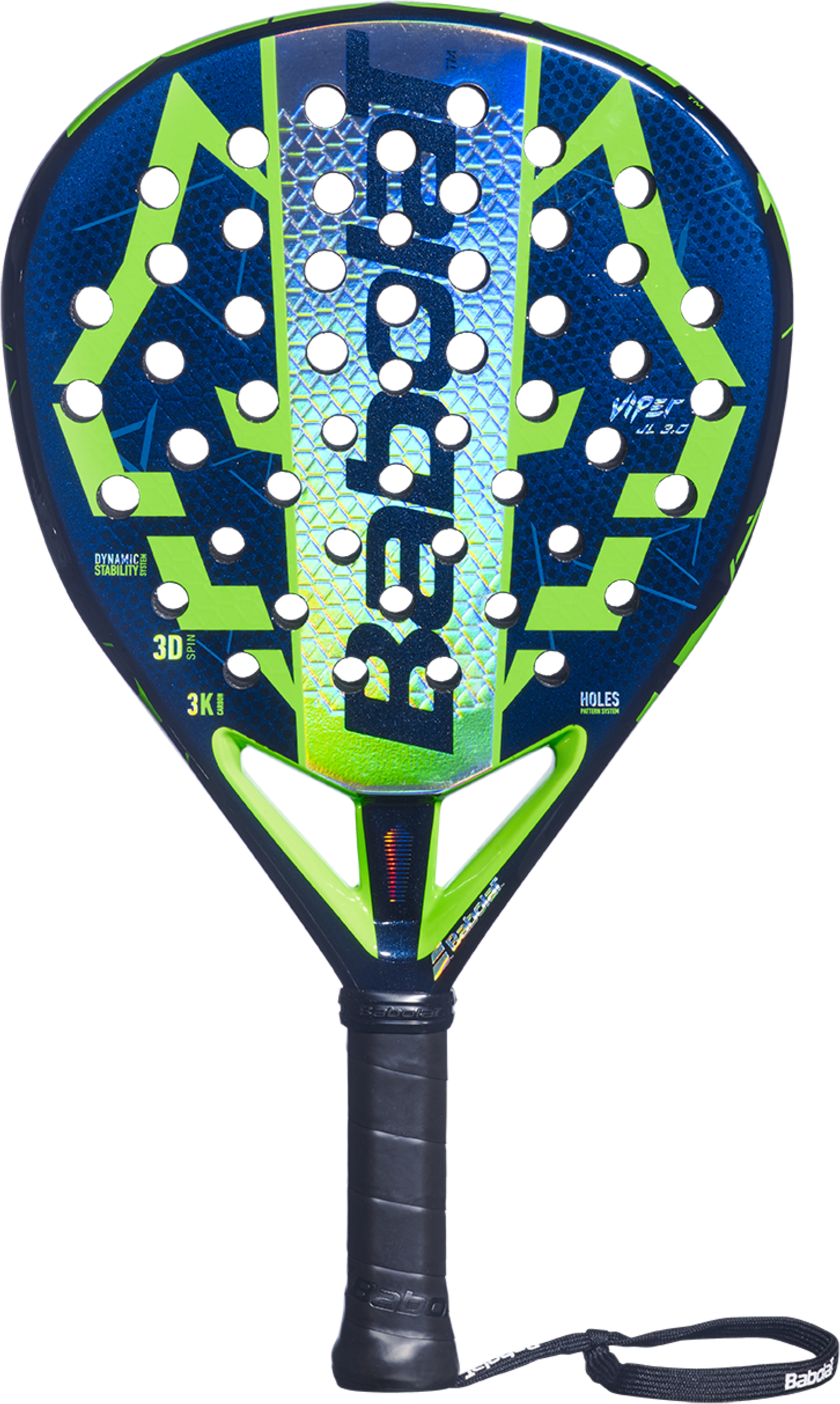
A head-heavy diamond built around explosive overheads — the kind of frame that rewards clean contact at the top of the bounce and exposes everything else.
Where to buy
As an Amazon Associate, Padelhost earns from qualifying purchases at no extra cost to you. This never affects our recommendations.
Amazon
Check price & availability
Link opens in a new tab · we may earn a commission
Full spec breakdown
Listing checked at publish date
Highlights
What makes this racket stand out
Diamond head with high balance — sweet spot sits high for smashes, víboras and bandejas from the left
3K carbon face over a Hard EVA core delivers immediate ball exit with minimal dwell time
Dynamic Stability System bar through the throat stiffens the frame so the head doesn't twist on off-centre contact
The feel
How it's built to play, by shape, core and construction — rated low / mid / high rather than on a false 1–10 scale. Higher isn't always better; it depends on the game you want.
Balance — where the weight sits
Even
Handle / low
Head / high
The spec sheet
Weight
360–380g
Shape
Diamond
Level
Professional
Style
Power
Balance
High
Core
Hard EVA
Face
3K carbon
Thickness (mm)
38
Our verdict
What the shape, core and construction tell us about how this racket is built to play.
The short version
The Viper Juan Lebrón 3.0 FW makes sense for one specific buyer: the left-side player with clean overhead technique who wants the frame to amplify power rather than provide it. What stands out is how solid the head feels on smashes — the Dynamic Stability bar genuinely keeps the racket planted on mishits that would twist a softer diamond. The problem is everything that comes with that profile: it's stiff, it's head-heavy, and it's an arm-health risk for anyone who isn't already swinging confidently at this level.
Strengths
Left-side attackers who finish points overhead and want a frame that punches through balls rather than guiding them
Advanced and competition-level players with consistent technique on smashes and aggressive volleys
Keep in mind
Beginners, right-side defenders, or anyone with elbow or shoulder history — the diamond shape, high balance, Hard EVA and stiff 3K carbon stack four high-risk arm factors in one racket
How it's built to play
The Viper Juan Lebrón 3.0 FW is the racket Juan Lebrón competes with on the Premier Padel circuit, and it's built the way a left-side attacker actually wants a left-side racket built: heavy in the head, stiff through the face, and unapologetic about punishing players who don't deserve the spec sheet. At 370g (±10g) with a diamond head and a balance pushed toward the tip, it's a finishing tool first and a defensive racket a distant second.
The face is 3K woven carbon — a tighter weave than 1K, stiffer than 12K-and-up, and it gives the surface a hard, immediate response that doesn't flex on contact. Energy goes where the player aims it; there's no trampoline assist to bail out a bad swing. Under that sits a Hard EVA core, which keeps dwell time short and rebound fast — the ball leaves the strings quickly rather than sinking in for spin sculpting.
The Dynamic Stability System is the piece worth understanding: a reinforced bar through the heart of the racket that stiffens the throat area, so when you catch a smash slightly off-centre the head doesn't twist and bleed power. On a 370g diamond that lives or dies by what happens above the sweet spot, that bar is doing real work. The textured surface adds bite for víboras and topspin smashes — useful given how much of Lebrón's actual game runs on shaped balls rather than flat power.
Overhead, this is where the racket earns its price. The mass sits high, the core is hard, and the carbon face transfers everything — smashes through the glass and víboras down the middle come out heavy and fast with very little effort from the arm. Volleys at the net feel direct and short, with no mushy give before the ball leaves.
The trade-offs are exactly what the specs predict. From the back of the court on slower balls, the lack of dwell time means you have to generate your own pace — there's no spring to help reset a defensive lob. Off-centre contact sends a clear sting up the arm, and the head-heavy swing weight is tiring across a long match if your forearm isn't conditioned for it. Right-side players will find it slow to reposition between quick volley exchanges.
FAQ
How does the Viper Juan Lebrón 3.0 FW compare to the previous Viper 2.0?
The 3.0 FW adds the Dynamic Stability System bar through the throat, which is the main on-court difference — the head feels more planted on off-centre smashes than the 2.0 did. The 3K carbon face and Hard EVA core carry over, so the overall identity (diamond, head-heavy, power-first) is unchanged. If you already play the 2.0 well, the 3.0 is an evolution rather than a different racket.
Should I choose the Viper Juan Lebrón 3.0 FW or a Bullpadel Vertex 04?
Both are left-side diamond rackets aimed at attackers, and both will punish a player who isn't ready. The Viper 3.0 FW feels slightly more reactive off the face thanks to the 3K carbon and stability bar; the Vertex tends to feel marginally more forgiving on mishits. Pick by feel in hand — the spec sheets are closer than the price tags suggest.
Can I use this racket on the right side?
You can, but you're working against the design. The high balance slows the racket through quick volley exchanges, and the Hard EVA core gives less control on reset shots than a softer foam would. Right-side players are better served by a teardrop or round shape with lower balance.
Is the Viper 3.0 FW safe for players with elbow problems?
No — this racket combines four of the highest-risk factors for elbow strain: diamond shape, high balance, Hard EVA core and stiff 3K carbon face. Players with a history of lateral epicondylitis or shoulder issues should look at a round or teardrop frame with a softer core and lower balance.
What does the Dynamic Stability System actually do in a match?
It's a reinforced bar through the heart of the racket that stiffens the throat area. On contact, it stops the head from twisting when you catch a smash or volley slightly off-centre — so the ball still comes out with pace instead of dying on a mishit. On a 370g diamond, where small errors cost a lot of power, that stability is the difference between a winner and a setup ball for the opponent.
Ready to add this to your game?
A head-heavy diamond built around explosive overheads — the kind of frame that rewards clean contact at the top of the bounce and exposes everything else.
Link opens in a new tab · we may earn a commission